A bottle is ready. Your baby finishes it quickly. Then comes the familiar question: add an ounce next time, or stay put? That is what a formula feeding chart by age is for. It gives a practical baseline when a clear starting point is needed.
Think of the chart as a starting point, not a rulebook. In real life, the best adjustments come from three things: your baby’s weight, total intake over 24 hours, and the hunger and fullness cues that show up around feeds. Most newborns begin with about 1 to 2 ounces every few hours, but bottle sizes change as babies grow. Use the chart to get into the right range, then fine-tune based on how your baby’s appetite shifts from week to week.
Table of Contents
- Formula feeding chart by age
- How to adjust by weight and daily totals?
- How to adjust by month, weight, and cues?
- How to tell if your baby needs more or less?
- How to adjust for growth spurts and changing weight?
- Mixed feeding and pumping while using formula
- Conclusion
Formula feeding chart by age
Here is a age-based chart built from guidance commonly reflected by the American Academy of Pediatrics(AAP).
| Stage | Suggested volume | Feeding frequency | Daily total (feeds/day) |
| The first week | 1 to 2 oz | Every 2 to 3 hours | 8 to 12 |
| The first month | 2 to 3 oz | Every 2 to 3 hours | 8 to 12 |
| By the end of the first month | 3 to 4 oz | About every 4 hours | 8 to 10 |
| By 6 months of age | 6 to 8 oz | About every 4 hours | 4 to 6 |
These numbers are a starting range, not a hard rule. They are useful for answering “What is typical at this age?”, but they cannot tell you exactly what your baby needs on any given day. For a clearer picture, look at overall weight gain, wet nappies, and how your baby settles after a feed.
One helpful way to think about it is this:
- Age tells you the usual range.
- Weight helps estimate the daily total.
- Baby cues tell you whether today’s bottles still make sense.
How to adjust by weight and daily totals?
According to AAP guidance, many babies take about 2.5 ounces of formula per pound of body weight over 24 hours.
That simple rule of thumb helps explain why two babies the same age can do well on different bottle sizes. A younger baby with faster weight gain may need more than the “average” age chart suggests, while another baby may stay on the lower end and still be doing just fine.
There is also a practical upper boundary. One thing the AAP points out is that most babies tend to tap out at around 32 oz a day. Now, that’s not a hard “shut-off” valve for every single bottle, but if you notice your little one is constantly blowing past that mark, it’s a good idea to bring it up at your next pediatrician visit.
To get a real feel for where you stand, try keeping an eye on these two numbers for a few days:
- Single-feed volume
- Total intake over 24 hours
As babies grow, bottles often get larger and feeds tend to space out. Fewer feeds in a day is not automatically a concern if total intake over 24 hours, wet nappies, and growth are staying steady. Age can set a broad range. Weight and daily totals help confirm whether the overall pattern still fits.
How to adjust by month, weight, and cues?
If you want the “month-to-month” chart to work better in real life, use this three-layer check before you change your formula feeding schedule:
| Layer | Question to ask | What to look at |
| Age (month) | What is typical right now | Usual ounces per feed and feeding frequency ranges |
| Weight | Does the daily total still fit my baby | Roughly 2.5 oz per pound per day as a starting point |
| Cues + output | Is today’s plan working | Hunger/fullness cues, wet diapers, comfort, steady growth |
This approach tends to matter most in the first 8 to 12 weeks, when feeding patterns can change quickly. Try not to get stuck on what a chart says your baby “should” be doing. If weight gain is steady, your baby settles after feeds, and a little milk is sometimes left in the bottle, the amount may already be working.
On the other hand, if bottles are being finished consistently and hunger cues keep showing up soon after, it can make sense to increase a feed rather than waiting for a calendar milestone.
How to tell if your baby needs more or less?
Charts are useful, but baby cues are what help you adjust in real time.
Signs your baby may still be hungry
- Finishing bottles quickly and still rooting
- Smacking lips or sucking hands right after a feed
- Getting hungry much sooner than usual for several feeds in a row
- Showing a short-term increase in appetite during a known growth spurt
Signs your baby may be full
- Slowing down or stopping sucking
- Turning away from the bottle
- Pushing the nipple out with their tongue
- Relaxing hands and body after the feed
- Falling asleep content rather than frustrated
Signs the overall intake may be going well
- Steady weight gain
- Regular wet diapers
- Reasonable contentment between feeds
If your baby is constantly fussy after eating, maybe they’re spitting up a lot, arching their back in pain, or their intake is just all over the place for days on end. That’s a clear signal to check in with your pediatrician. A feeding chart can only tell you so much; some patterns really need a professional’s eye rather than a DIY fix based on a graph.
How to adjust for growth spurts and changing weight?
Charts are best used as a “typical range” baseline. Growth spurts and weight changes can make appetite shift from one day to the next. When that happens, it helps to make small, measured adjustments rather than reacting to a 48-hour swing. Flexibility matters more than perfect consistency.
During a growth spurt, babies often:
- Want to feed sooner than usual
- Finish bottles faster
- Wake more often overnight
- Seem fussier for a few days
If your baby seems hungrier across several feeds, a small increase is often enough, such as adding 1 to 2 oz to a bottle or adding one extra daytime feed. Then look at the pattern over the next day or two. If things settle, it was likely a short growth phase rather than a sign that the whole routine needs changing.
Weight changes matter too. If your baby has moved up meaningfully in weight, revisit the daily ounces estimate. A chart by age only gets you halfway there. Age tells you what is common. Weight tells you what may be needed now.
The same principle applies when your baby starts to go longer at night. A longer stretch of sleep can be completely normal if total daytime intake still holds up and weight gain stays steady. The chart should help you notice trends, not panic over every schedule change.
If pumping becomes part of your plan during these transitions, focus on what helps you stay consistent, like comfort, portability, and how quickly you can set up and clean up. If you want to compare different pump styles in one place, the eufy breast pump can be a simple place to compare options.

Mixed feeding and pumping while using formula
Mixed feeding is common. Some families use it because of supply, work, or latch challenges. Others use it simply because it is the routine that feels sustainable day to day.
Here is the key idea: your baby’s daily intake is one bucket, and it can be filled by nursing, pumped milk, and formula. The age chart helps you estimate a baseline, but in mixed feeding you also need a plan for milk removal if maintaining or increasing supply matters to you.
How nursing, pumped milk, and formula work together
Nursing: feeds your baby directly, milk removal built in
Pumped milk: breast milk by bottle, milk removal via pump
Formula: covers a feed reliably, no milk removal
In mixed feeding, the most helpful mental model is to separate calories (what baby drinks) from milk removal (what protects supply).
Practical rules that make mixed feeding less confusing
- Swap: If formula replaces a nursing feed and supply is a priority, add a pump session to replace the milk removal.
- Pick one goal: This week, optimize for predictability, sleep, or supply, then make decisions that match that goal.
- Zoom out: Adjust based on 24-hour totals, diapers, and growth, not one unusually small (or unusually large) bottle.
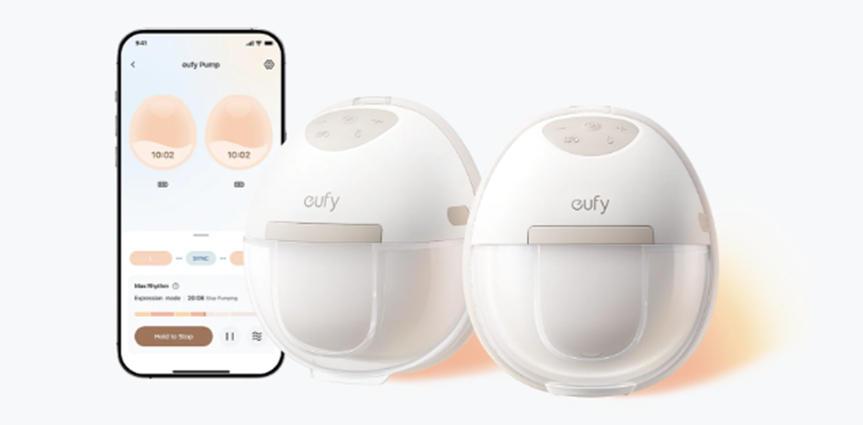
If the hard part is not “what should I do,” but “when will I realistically do it,” a wearable pump can make pumping easier to keep in your day. One example is the eufy Wearable Breast Pump E20, which is designed for in-bra pumping and includes a gentle warming option for comfort during daytime sessions between bottles.
General information only, not medical advice
eufy Wearable Breast Pump E20
Conclusion
A formula feeding chart by age can make the early months feel more manageable, especially when the same question keeps coming up: is this amount typical? A chart is only a starting point. Your baby’s weight, feeding cues, and growth pattern are what guide the next decision. Use the numbers to get into the right range, then look at the bigger picture before making changes. And if something feels off, it is worth discussing with your paediatrician. The goal is a flexible guide that fits a real baby, not a rigid rulebook.
Thank you for reading.







