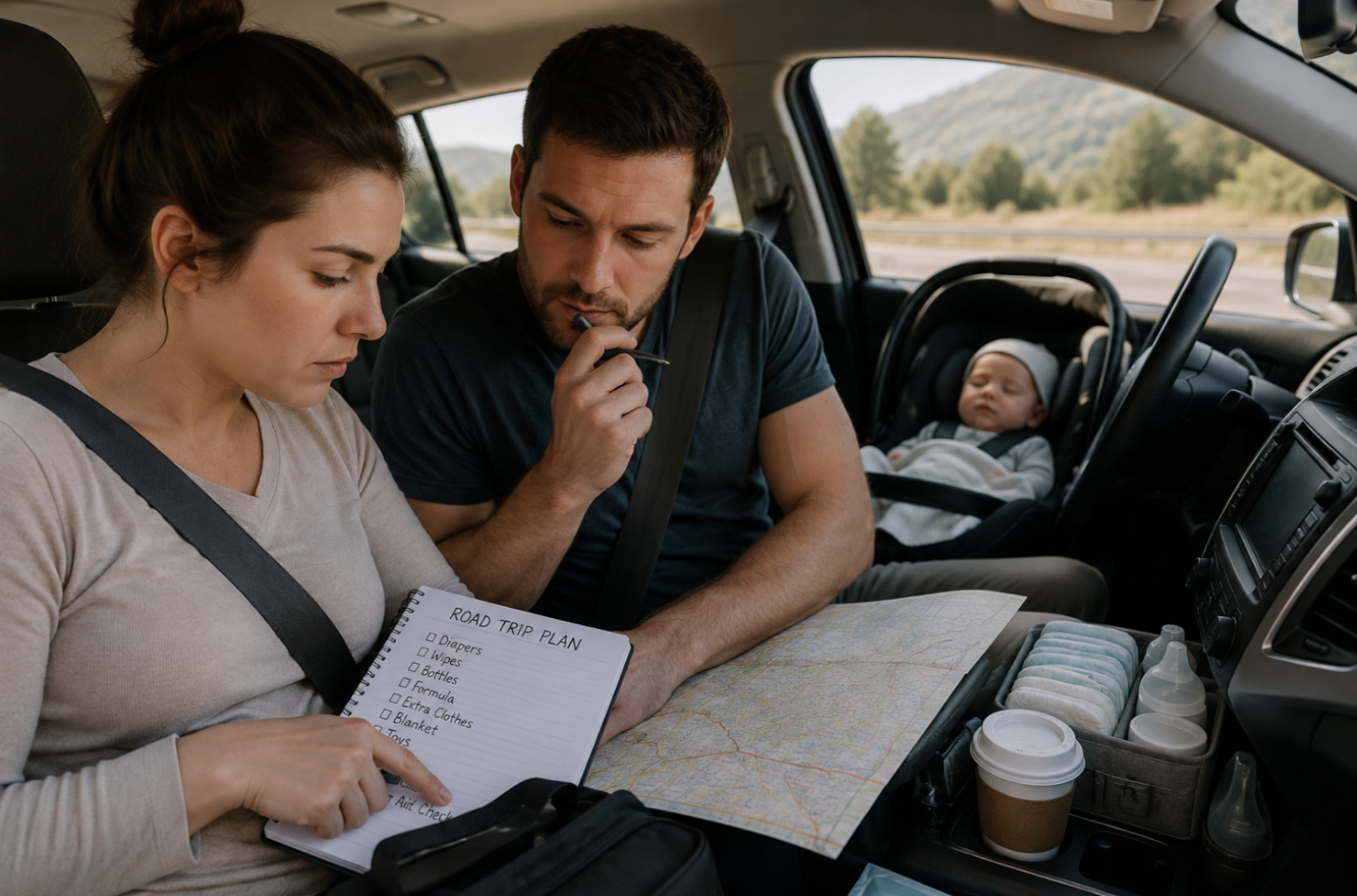
A road trip with an infant is not a shorter version of a road trip with a toddler. It is a different exercise entirely, governed less by entertainment and more by a feeding schedule that does not care about your estimated arrival time.
The good news is that almost everything that goes wrong on these drives is predictable, which means it is preventable. Here is how the trip breaks down.
Before the Car Is Loaded
Build the route around stops rather than distance. The American Academy of Pediatrics advises taking a break roughly every two to three hours on a day trip and every four to six hours at night. Work out where those stops land before you leave, because discovering at hour three that the next 40 miles is farmland changes the mood in a car considerably.
Worth clearing up, since it circulates constantly: the AAP does not state a maximum amount of time a baby may spend in a car seat. The widely repeated “never more than two hours” rule is not an AAP position. What the AAP does say is the break interval above, and separately, that a car seat should not be treated as a safe sleep space outside the vehicle. If your baby falls asleep in the seat, the AAP’s guidance is to move them to a firm, flat sleep surface on their back as soon as you can. Bring a portable play yard if you are not certain a safe sleep space is waiting at the other end.
Pack the cooler on the assumption of delay. The CDC allows expressed milk up to 24 hours in an insulated cooler with frozen ice packs, which comfortably covers a long driving day. Milk that has fully thawed should not be refrozen, though the CDC notes that milk still containing ice crystals can be.
The First Leg
Leave after a full feed, not before one. The most common planning error is departing on schedule with a hungry baby, which converts the first 30 minutes into the worst 30 minutes.
Put the caregiving parent in the back seat if there are two adults. It sounds excessive until the first time a pacifier goes missing at 65 miles per hour. If you are driving alone, accept now that you will stop more often than the map suggests, and stop the moment you think about stopping rather than pushing to the next exit.
The Middle Hours
This is where the trip is won or lost, and mostly it comes down to whether pumping is possible without adding an hour to the day.
Roadside pumping is a logistics problem more than a privacy one. A pump that runs on its own battery and needs no outlet or flat surface makes the difference between a session at a rest stop and a session that gets skipped. The BabyBuddha 3.0 Primary Portable Breast Pump with EasyFit Kit charges over USB-C and includes a flange ruler and inserts stepping down from the 24mm base, a detail that matters on the road specifically, because a poor fit that is merely annoying at home becomes genuinely painful across a long day.
Expect output to be lower than usual. Travel days disrupt the pattern, and a disrupted pattern shows up in the bottle. That is a short-term effect rather than a supply problem, and it typically resolves once you are back on a normal rhythm. If it lingers past a few days, the standard response is to add a structured session that imitates a cluster feed. Many parents use power pumping for exactly this, once a day for about a week rather than expecting an overnight change.
Feed at the stops, never in a moving vehicle. Combine your stops so one pull-off covers the diaper change, the feed, and the pump session rather than spreading them across three exits.
Arrival
Do not try to reconstruct the normal bedtime routine on night one. Get the safe sleep surface set up first, before the bags, before anything else. Everything else can wait until morning.
Plan for a rough first night and a better second one. Infants adjust to new environments reasonably quickly, but the adjustment is rarely instant, and expecting it to be is how a decent trip gets remembered as a bad one.
If You Fly Instead
The rules are more generous than most travelers realize, and airport staff sometimes get them wrong.
- Breast milk, formula, and toddler drinks in quantities greater than 3.4 ounces are permitted in carry-on baggage. The TSA classifies them as medically necessary liquids, so the standard liquid limit does not apply.
- Your child does not need to be present. The TSA states plainly that you may bring breast milk, formula, and related supplies without the infant traveling with you.
- Ice packs, freezer packs, and frozen gel packs are allowed, including when partially thawed.
- Tell the officer at the start of screening and remove these items to be screened separately. Officers may test the liquids. Clear translucent bottles move faster than pouches, which sometimes have to be opened for testing.
Print that list or save a screenshot. Being able to point at the actual rule resolves most disagreements at the checkpoint quickly.
The Short Version
- Route the drive around AAP break intervals, every two to three hours by day, four to six at night.
- Ignore the “two hours maximum in a car seat” rule. It is not an AAP position. The sleep-surface guidance is the real one.
- Leave after a feed, not before.
- Combine each stop: diaper, feed, pump. One pull-off, three jobs.
- Pack an insulated cooler with frozen ice packs and count on 24 hours of coverage.
- Expect lower output on travel days and treat it as temporary.
A long drive with a newborn is a project with a lot of moving parts, but the parts are known. Plan the stops, feed before the wheels turn, and give yourself permission to arrive two hours later than you told everyone.
Thank you for reading.







